
The day before I introduced our unit on the culture wars, a student hung back after class. She waited until the room cleared out, walked up slowly, and said, almost in a whisper, “Are we really going to have to say what we actually think about all of this?”
I said yes. She nodded, looked at the floor for a second, and said, “I just… I don’t want people to think I’m a bad person because of what my family believes.”
I told her I understood. And I meant it.
That conversation has stayed with me for years because it captures exactly what makes teaching controversial topics so complicated. It’s not just about the content. It’s about the fact that your students are real people with real families, real beliefs, and real fears about being judged.
And yet, avoiding these conversations doesn’t protect them. It just leaves them without the tools to navigate a world that is full of hard disagreements.
The data backs this up: nearly half of social studies teachers feel pressure to avoid controversial topics in class, according to a 2025 RAND survey. And right now, that number is growing.
But here’s the thing: students don’t stop thinking about Culture Wars, political polarization, or social conflict just because we don’t address them in class. They just process it without us.
The good news? You can do this well. It takes structure, preparation, and a clear plan, but you absolutely can facilitate a discussion on a controversial topic without it turning into a shouting match. This post walks you through exactly how.
Why Controversial Topics Are Worth Teaching (Even When It’s Hard)
Let’s address the elephant in the room: is it even appropriate to discuss controversial topics in a social studies classroom?
Yes. Emphatically yes.
Students who engage in structured discussions about controversial topics show stronger civic knowledge, greater political tolerance, and higher levels of civic participation as adults. That’s the finding from a landmark Education Week study, and it’s hard to ignore.
Avoiding hard conversations doesn’t make students more comfortable. It makes them less equipped.
That said, there’s a real difference between a classroom discussion gone wrong and one that’s thoughtfully facilitated. The difference is your preparation.
Step 1: Set Clear Norms Before You Ever Touch the Content
The number one reason classroom discussions fall apart is that students don’t know the rules of engagement before they start. They walk in thinking this is a debate, or a vent session, or a chance to convince everyone else they’re wrong.
Before you introduce any controversial topic, take time to co-create discussion norms with your class. You can even have students help create the norms.
For example, at the beginning of the school year, I have students write down discussion norms that are important to them on a sticky note. I then take their responses and put them in a word cloud. I hang up the word cloud and give each student a copy.
Effective norms typically include:
- Speak from your own experience, not on behalf of a group
- Critique ideas, not people
- Ask questions before you push back
- It’s okay to change your mind
When students help create discussion norms, they’re significantly more likely to follow them, and more likely to engage authentically. That’s a key finding from UCL’s Centre for Holocaust Education, which has done extensive research on what makes difficult discussions actually work in classroom settings.
Post the norms visibly. Refer back to them. And when things get tense (because they will), point to the norms instead of pointing at students.
Step 2: Require Research Before the Discussion Starts
One of the biggest mistakes teachers make is jumping straight into discussion without giving students time to build background knowledge first. When students walk in underprepared, the conversation stalls or devolves into uninformed opinion-sharing.
Before your discussion day, assign structured research that helps students:
- Understand the historical and social context of the issue
- Identify multiple perspectives, including ones they may disagree with
- Evaluate the credibility of their sources
- Prepare specific evidence to support their thinking
This doesn’t have to be a full research paper. It can be a structured reading, a jigsaw activity, or a guided note-taking template. The goal is to ensure that when students open their mouths in discussion, they’re speaking from knowledge, not just reaction.
This step also helps quieter students participate. When everyone walks in with notes in hand, the student who’s nervous about speaking has something concrete to anchor to.
Perspective-taking exercises, like researching and presenting viewpoints you don’t personally hold, have been shown to build empathy and reduce polarization in students, according to researchers at the Greater Good Science Center at UC Berkeley. Which is exactly what you want going into a charged discussion.
Step 3: Choose the Right Discussion Structure
Not all discussions are created equal. The format matters as much as the content, and different structures work better for different types of controversial topics.
Here are three research-backed protocols to consider:
The Fishbowl Discussion
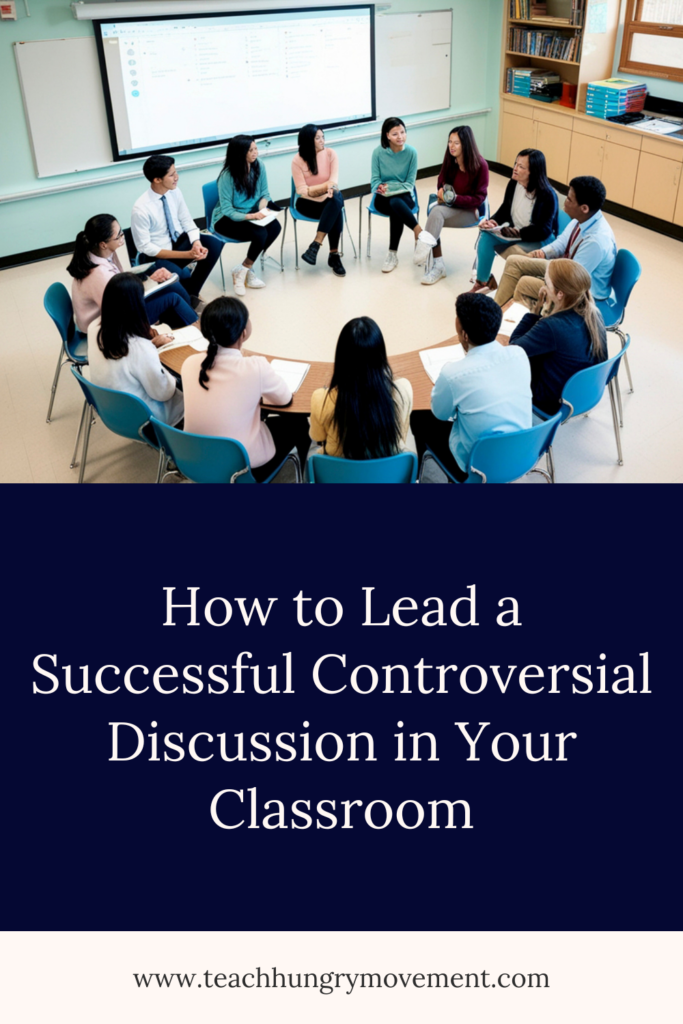
In a Fishbowl, a small group of students (usually 4 to 6) sits in the center of the room and discusses the topic while the rest of the class observes silently. After a set time, students rotate in and out of the inner circle.
This structure is particularly effective for Culture Wars topics because it lowers the stakes. Students in the outer circle get to hear and process multiple perspectives before they have to speak. Students in the inner circle know they’re being listened to carefully, which tends to raise the quality of their contributions.
If you’re planning to tackle the culture wars in your classroom, I’ve put together a ready-to-use Culture Wars Fishbowl Discussion Activity that gives you everything you need: discussion prompts, student role cards, a structured observation guide, and teacher facilitation notes. It’s designed specifically for AP Government and on-level Civics.
The Socratic Seminar
A Socratic Seminar is a student-led discussion anchored in a shared text or set of texts. The teacher facilitates with open-ended questions but largely stays out of the way. Socratic Seminars significantly improve students’ ability to articulate and defend a position using evidence, according to research from the University of Wyoming.
Best for: Topics where students have done substantial reading and need practice building arguments from evidence.
Structured Academic Controversy (SAC)
SAC was developed by cooperative learning researchers David and Roger Johnson, and it’s one of the most powerful tools in the controversial topics toolkit. Students argue one side of an issue, then switch sides and argue the opposite position, and finally work together to find common ground.
Best for: Topics where you want students to genuinely grapple with multiple perspectives rather than just defend their own view.
Step 4: Stay Neutral (But Not Silent)
Teachers often wrestle with whether to share their own opinions during controversial discussions. The short answer: usually not.
Your job in this context is to be a discussion facilitator, not a participant. That means:
- Asking follow-up questions that push students to elaborate
- Redirecting personal attacks back to the idea
- Bringing in underrepresented voices (“We haven’t heard from this side of the room yet…”)
- Summarizing and reflecting back on what you’re hearing
Staying neutral doesn’t mean staying passive. You can and should intervene when discussion norms are violated, when misinformation enters the conversation, or when a student seems genuinely distressed.
If you’re wrestling with exactly where the line is, Facing History and Ourselves offers some of the clearest guidance out there on teacher neutrality, including how to address factual inaccuracies without shutting down student thinking.
Step 5: Debrief Intentionally
What happens after the discussion matters just as much as the discussion itself.
Build in time to debrief with your class. Useful debrief questions include:
- What did you hear today that surprised you?
- Did anything change or complicate your thinking?
- What questions do you still have?
- What would you want to explore further?
One research-backed move: follow your discussion with a short reflective writing prompt, giving students time to process privately before moving on. The team at TeachingHistory.org makes a strong case for this, and it’s one of the easiest ways to help every student, including those who didn’t speak, actually internalize what happened.
This is also the time to check in with individual students who seemed particularly affected. A quick “how are you doing?” after class goes a long way.
The Goal Isn’t Agreement. It’s Practice.
You’re not trying to get your students to agree with each other, or with you. You’re trying to give them practice doing something genuinely hard: engaging with people who see the world differently, staying grounded in evidence, and walking away with their dignity and relationships intact.
That student who whispered her worry to me after class? By the end of the unit, she was one of the most thoughtful voices in the room. Not because she changed what she believed, but because she found a way to say it, and to really listen.
That’s what we’re building toward.
For even more discussion strategies, check out Make Social Studies Discussions Work for Even the Most Reluctant Students





+ show Comments
- Hide Comments
add a comment